
How to Get More Fibre Without the Fuss

What Is Dietary Fibre?
Dietary fibre is the part of plant foods that isn't completely digested and absorbed in the small intestine.
Instead, it travels further through your digestive system, where different types of fibre behave in different ways.
Fibre helps support normal bowel function and digestive health, but its importance goes well beyond keeping things moving. Higher-fibre eating patterns have also been associated with a range of long-term health benefits.
A large series of systematic reviews and meta-analyses published in The Lancet, for example, found that people with higher dietary fibre intakes had lower rates of several major chronic diseases compared with people consuming less fibre.
Most of your fibre should ideally come from foods such as fruit, vegetables, legumes, wholegrains, nuts and seeds, which bring plenty of other nutrients along for the ride.
How Much Fibre Do You Need Each Day?
For Australian adults, the current Adequate Intake for dietary fibre is:
- 25g per day for women
- 30g per day for men
You don't necessarily need to start counting every gram, just think of those numbers as useful context.
If breakfast is white toast, lunch is a cheese sandwich, afternoon tea comes from the office biscuit stash and dinner only features beige as a colour, there's probably room to add a little more.
Australian guidance recommends getting fibre from a variety of plant foods, including fruit, vegetables, legumes and wholegrain or wholemeal foods.
Variety matters because fibre isn't just one thing.

Soluble vs Insoluble Fibre
You may have heard fibre divided into soluble and insoluble types.
Most plant foods actually contain a mixture, so there's no need to build separate meal plans. But knowing the basic differences can be useful.
What Is Soluble Fibre?
Soluble fibre interacts with water and can form a gel-like substance as it moves through your digestive system.
You'll find it in foods such as:
- oats and barley
- beans, lentils and other legumes
- fruit
- vegetables
- psyllium
Soluble fibres vary considerably in how they behave, but some can help support healthy cholesterol levels and bowel function.
Konjac Root, also known as glucomannan, is another soluble, highly viscous fibre. It absorbs water and thickens considerably, which is why you'll commonly see glucomannan used in fibre-based products.
What Is Insoluble Fibre?
Insoluble fibre doesn't dissolve in water in the same way.
Instead, it generally helps add bulk as food moves through your digestive system.
You'll find plenty in:
- wholegrain breads and cereals
- wheat bran
- nuts and seeds
- fruit and vegetable skins
- beans and legumes
Rather than choosing one or the other, the simplest approach is to eat a variety of plant foods to make sure you're covering all bases.

The Easiest Way to Eat More Fibre
Before reaching for a supplement, look at what you're already eating.
You may be able to substantially increase your fibre intake without adding an entirely new meal or radically changing your diet.
Think upgrade, not overhaul.
Add Fibre to Breakfast
Breakfast is one of the easiest places to sneak in more fibre.
If you usually eat cereal, oats, toast or yoghurt, you've already got something to work with.
Try:
- swapping white bread for wholegrain
- choosing rolled oats or a higher-fibre cereal
- adding berries or sliced fruit
- sprinkling over chia seeds, flaxseed, nuts or seeds
- adding a spoonful of nut butter

Make Your Smoothie Do More
Smoothies can easily become a fibre dead zone if they consist entirely of protein powder and milk.
Keep the protein, but give it some plant-based company.
Try blending in berries, banana, oats, chia or flaxseed, spinach, or nut butter.
Using whole fruit rather than fruit juice also keeps more of the fibre naturally present in the fruit.
Give Lunch a Fibre Upgrade
You don't need a dedicated “high-fibre lunch”.
Just look for the obvious gaps.
- Having a sandwich? Try wholegrain bread and add salad.
- Making a wrap? Throw in beans, chickpeas or extra veg.
- Eating leftovers? Add a side of vegetables.
- Making a salad? Bulk it out with lentils, quinoa, chickpeas, seeds or wholegrains.
Beans and legumes are particularly handy because they bring both fibre and protein to the party.

Add More Plants to Dinner
Dinner is another place where small changes stack up.
Try adding:
- an extra vegetable
- beans or lentils to mince-based meals
- chickpeas to curries
- brown rice or another wholegrain
- skin-on potatoes
- a side salad
- nuts or seeds as a topping
You can even replace some of the mince in dishes like tacos, chilli or bolognese with lentils.
Same dinner. More fibre.
Choose Smarter Snacks
Fruit, nuts, roasted chickpeas and wholegrain crackers can all contribute fibre between meals.
And yes, convenience food can count too.
Our Protein Bars contain at least 20g of protein and, depending on the flavour, around 6.4–7.1g of dietary fibre per bar.

How to Increase Fibre Without Regretting Everything
Found out you're eating approximately four lentils a fortnight and decided tomorrow will be different?
Excellent enthusiasm. But maybe don't jump from very little fibre to an enormous amount overnight.
Increasing fibre quickly can cause extra gas, bloating and digestive discomfort in some people.
A recent systematic review of over 100 randomised trials found that increasing fibre had small-to-modest effects on measures including stool frequency, stool consistency and gut transit in generally healthy people, but the effects varied substantially depending on the type and amount of fibre.
In other words, more isn't automatically better all at once. Try making one or two changes, letting them become normal and then building from there.
Why Water Matters When You Eat More Fibre
Fibre and fluid are a team.
Many types of fibre interact with or absorb water, which is part of how they help support normal bowel function. That's why increasing fibre while forgetting about fluid isn't a particularly clever combo.
Keep drinking regularly throughout the day, particularly when you're deliberately increasing your fibre intake or using concentrated fibre products. This is especially important with fibres such as psyllium and glucomannan, which absorb significant amounts of water.
Do You Need a Fibre Supplement?
Not necessarily. If you're regularly eating vegetables, fruit, legumes, wholegrains, nuts and seeds and comfortably meeting your needs, there isn't a medal for finding another way to add fibre.
Food first is a very good default. But real life isn't always nutritionally picturesque.
Some days are busy. Some diets are restrictive. Some people simply struggle to get enough fibre-rich food into their usual routine.
That's where a fibre supplement can become a convenient top-up rather than a replacement for a varied diet.
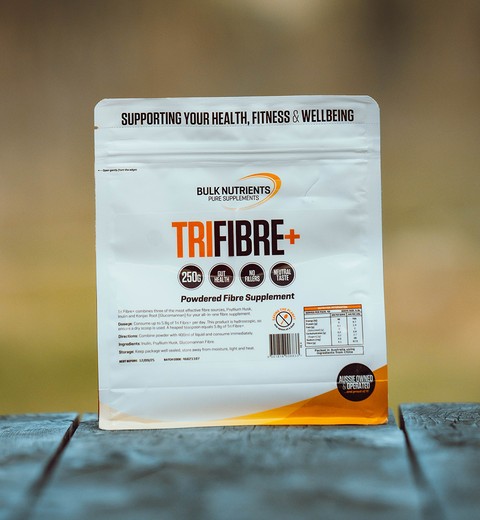
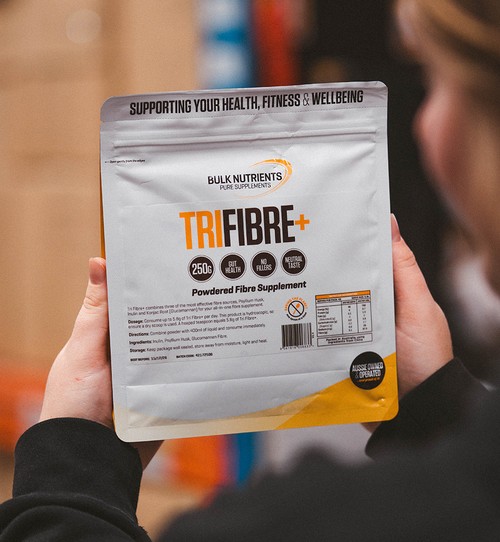
If you're simply looking to add more fibre, Tri Fibre+ provides 5.1g of dietary fibre per 5.8g serve from inulin, psyllium husk and glucomannan from Konjac Root.
Digestive Fusion takes a broader approach, providing 3.2g of fibre per serve alongside a blend of other ingredients including prebiotics, probiotics, vitamins and minerals.
Which makes the choice fairly simple: start with what you're already eating, then use convenience products where they genuinely make your routine easier.

A Simple High-Fibre Day
Still wondering what this looks like when actual food gets involved?
Here's one example.
- Breakfast: Rolled oats topped with banana, berries and chia seeds.
- Lunch: A wholegrain chicken or tofu wrap with salad and chickpeas.
- Snack: A piece of fruit, handful of nuts or a Protein Bar.
- Dinner: Salmon, chicken, lean beef or tofu with brown rice and a generous serve of mixed vegetables.
You don't need one enormous fibre hit. Spread fibre-rich foods across breakfast, lunch, dinner and snacks and your daily target becomes much easier to reach.
Fibre Without the Fuss
Fibre might never be the most exciting thing in your supplement cupboard or shopping trolley. And that's fine.
It doesn't need better branding. It just needs a place in your routine.
Start with food. Add more plants. Make easy swaps. Increase gradually. Drink your water. And when convenience helps, use it.
References:
- Reynolds A, Mann J, Cummings J, Winter N, Mete E, Te Morenga L. Carbohydrate quality and human health: a series of systematic reviews and meta-analyses. Lancet. 2019 Feb 2;393(10170):434-445. doi: 10.1016/S0140-6736(18)31809-9. Epub 2019 Jan 10. Erratum in: Lancet. 2019 Feb 2;393(10170):406. doi: 10.1016/S0140-6736(19)30119-9. PMID: 30638909. https://pubmed.ncbi.nlm.nih.gov/30638909/
- Fayet-Moore F, Cassettari T, Tuck K, McConnell A, Petocz P. Dietary Fibre Intake in Australia. Paper I: Associations with Demographic, Socio-Economic, and Anthropometric Factors. Nutrients. 2018 May 11;10(5):599. doi: 10.3390/nu10050599. PMID: 29751656; PMCID: PMC5986479. https://pmc.ncbi.nlm.nih.gov/articles/PMC5986479/
- Nutrition Australia: What is Fibre? https://nutritionaustralia.org/resources/fibre-2/
- Daley SF, Shreenath AP. The Role of Dietary Fiber in Health Promotion and Disease Prevention: A Practical Guide for Clinicians. [Updated 2025 Dec 1]. In: StatPearls [Internet]. Treasure Island (FL): StatPearls Publishing; 2026 Jan-. https://www.ncbi.nlm.nih.gov/books/NBK559033/
- Balk EM, Couch E, Ja Mai H, Chen Y, Adam GP, Kanaan G, Caputo EL, Trikalinos TA, Williams G, Duncanson K, Talley NJ, Lichtenstein AH. Fiber Intake and Laxation in People With Normal Bowel Function: Systematic Review [Internet]. Rockville (MD): Agency for Healthcare Research and Quality (US); 2025 Jul. Report No.: 25-EHC037. PMID: 41264751. https://pubmed.ncbi.nlm.nih.gov/41264751/