
A Beginner’s Guide to Calisthenics

Why Calisthenics Can Build Muscle
Muscle growth—aka hypertrophy—happens when you challenge your muscles enough to force adaptation. This doesn't require heavy weights, just sufficient tension, volume, and progression over time.
Bodyweight exercises do this through:
- Mechanical tension: Using your own weight as resistance.
- Metabolic stress: High reps, short rest.
- Progressive overload: Increasing difficulty over time.
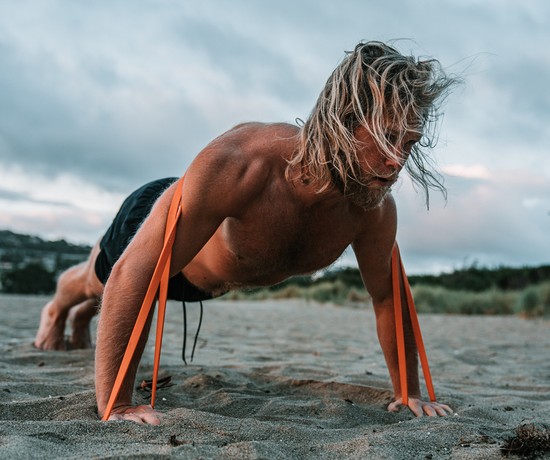
For example, you might start with incline push-ups on a bench, then move to full push-ups, then to decline push-ups, and eventually one-arm push-ups. Each step increases the demand on your muscles.
Studies comparing push-ups to bench presses (when matched for effort) found similar improvements in strength and muscle mass.
In other words, your body doesn’t care if you’re pushing against a barbell or the floor—it cares that you’re pushing hard enough.

The Big Four: Foundational Bodyweight Movements
These moves are the bread and butter of bodyweight strength. Think of them as your no-membership-required training toolkit. They’re versatile, scalable, and can be made harder or easier depending on your level.
Push-Ups
Classic for a reason. Target chest, shoulders, triceps, and core.
Progressions:
- Incline push-ups (hands elevated) – easiest
- Flat push-ups
- Decline push-ups
- Archer push-ups
- One-arm push-ups – hardest
Technique tips:
- Full range of motion: chest to floor.
- Engage core (no saggy hips – your lower back will thank you).
- Control the eccentric (lowering) phase slowly.

Pull-Ups
Pulling is crucial for balanced development. Targets lats, biceps, and upper back.
Progressions:
- Negative pull-ups (jump up, lower slowly)
- Band-assisted pull-ups
- Standard pull-ups (overhand grip)
- Chin-ups (underhand) – more biceps
- Archer or one-arm pull-ups – advanced
Pro tip: Eccentric work (slow lowering) builds strength even if you can’t do a full rep yet.
Squats
Lower body staple. Train quads, glutes, hamstrings, and calves.
Progressions:
- Box squats (limit depth for beginners)
- Full bodyweight squats
- Split squats/lunges
- Bulgarian split squats
- Pistol squats – ultimate single-leg challenge
Technique matters:
- Knees track over toes.
- Controlled descent.
- Don’t bounce at the bottom.
Dips
Great for chest, shoulders, and triceps.
Progressions:
- Bench dips (easier)
- Parallel bar dips
- Ring dips – big stability demand
- Korean dips or weighted dips – advanced
Form cues:
- Keep shoulders down and back.
- Control depth (aim for 90 degrees or slightly deeper).
- Avoid flaring elbows excessively.

Beyond the Basics: Using Progressions for Overload
Progressive overload is the magic sauce for muscle growth. Just because you’re not stacking plates doesn’t mean you can’t turn up the heat.
Strategies to progress:
- Leverage changes: Incline → flat → decline push-ups. The lower your hands go, the more of your body you lift.
- Unilateral work: One-arm push-ups, pistol squats. Doubles the load on one limb.
- Tempo manipulation: Slow eccentrics (5-10 seconds down), pauses at the bottom.
- Volume: More sets and reps.
- Shorter rest intervals: Increases metabolic stress.
- Isometrics: Holds at challenging positions.
For example, slowing down your push-up eccentric (the lowering phase) or adding a pause at the bottom makes it way harder, even though your bodyweight hasn't changed.
This concept is vital: progressive overload is the key to muscle growth. If you keep pushing yourself with harder variations, your body has no choice but to adapt.
Technique and Range of Motion: The Secret Sauce
Too many people short-change bodyweight exercises with sloppy half-reps.
If you want calisthenics to really work for you, you need:
- Full range of motion: Chest touches floor in push-ups, deep squats
- Controlled movement: No bouncing or half-reps
- Mind-muscle connection: Feel the working muscle
It’s easy to rush through reps for higher numbers. But slow, controlled reps with good form will stimulate far more growth.

Bodyweight vs. Weighted Training: Pros and Cons
Let's be real—each approach has its strengths.
Pros of bodyweight training:
- In theory, you can train anywhere – no gym required.
- No or minimal equipment needed.
- Joint-friendly variations.
- Encourages balance, coordination, and body control.
- Endless variations, progressions.
- Great for functional strength.
Cons:
- Harder to isolate muscles (e.g. biceps curls).
- Challenging to progressively overload for advanced users.
- Some muscle groups can be limited without equipment.
Pros of weighted training:
- Easier to precisely adjust load.
- Better for maximal strength in certain lifts.
- Simpler progression – just add weight.
Cons:
- Equipment or gym membership required.
- Higher costs.
- Easier to acquire an injury if form slips.
Bottom line: You don’t have to pick one over the other. Many people blend calisthenics with weights for the best of both worlds.

Optimising Bodyweight Training with Nutrition and Supplements
Just because you’re training without weights doesn’t mean you can skimp on nutrition. Recovery, performance, and muscle growth still depend on fueling your body right.
Here are a few supps to help you make the most of your bodyweight workouts:
- High-quality, fast-digesting protein to kickstart muscle repair post-workout.
- Delivers essential amino acids for growth.
Shake right after your calisthenics circuit to maximise recovery.
- Supports joint, tendon, and skin health.
- Useful for high-volume training where joint integrity matters.
Mix with water or add to coffee or smoothies to support healthy connective tissues.
3. Earth Protein (plant based)
- Dairy-free option for plant-based diets.
- Great for dual-user households.
Blend with oats and fruit for a tasty post-workout smoothie.
4. BCAAs
- Helps support muscle retention during long workouts or fasted training.
- May reduce muscle soreness and fatigue.
Sip during high-rep calisthenics sessions.
- Essential electrolytes to replace what's lost through sweat.
- Helps prevent cramps and maintain performance during long, sweaty sessions.
Mix with water during summer workouts or tough HIIT bodyweight sessions.

Final Thoughts: No Gym? No Excuse.
Calisthenics is more than an alternative—it’s a legit training style that can build strength, muscle, mobility, and control.
It’s democratic. Anyone can start, anywhere. With progression and technique, you’ll be amazed at what your body can do.
And with Bulk Nutrients in your corner, you’ll have the nutritional tools to recover, grow, and stay hydrated—no matter where your gym is.
So go ahead. Hit the ground (literally) and push yourself.
Nick is Bulk's Customer Service team's Technical Support Officer.
Which is our way of saying he's the guy whose job it is to answer your obscenely technical supplement questions.
More about Nick TelescaReferences:
- Calatayud J, Borreani S, Colado JC, Martin F, Tella V, Andersen LL. Bench press and push-up at comparable levels of muscle activity results in similar strength gains. J Strength Cond Res. 2015 Jan;29(1):246-53. doi: 10.1519/JSC.0000000000000589. PMID: 24983847. https://pubmed.ncbi.nlm.nih.gov/24983847/
- Kotarsky CJ, Christensen BK, Miller JS, Hackney KJ. Effect of Progressive Calisthenic Push-up Training on Muscle Strength and Thickness. J Strength Cond Res. 2018 Mar;32(3):651-659. doi: 10.1519/JSC.0000000000002345. PMID: 29466268. https://pubmed.ncbi.nlm.nih.gov/29466268/
- Mear E, Gladwell VF, Pethick J. The Effect of Breaking Up Sedentary Time with Calisthenics on Neuromuscular Function: A Preliminary Study. Int J Environ Res Public Health. 2022 Nov 7;19(21):14597. doi: 10.3390/ijerph192114597. PMID: 36361476; PMCID: PMC9653850. https://pmc.ncbi.nlm.nih.gov/articles/PMC9653850/

Whey Protein Isolate
$79.00
BCAA Recovery
$28.00
Earth Protein
$42.00
Collagen Protein
$50.00